
Accelerate your innovations by reducing time, cost and risk with orthopedic simulations
Our products and services help you develop cutting edge designs for orthopedics implants and joint replacements, within reduced time frames and costs. We provide objective, data backed solutions to help you address a wide array of development challenges such as determining load-bearing requirements and fulfilling regulatory obligations.
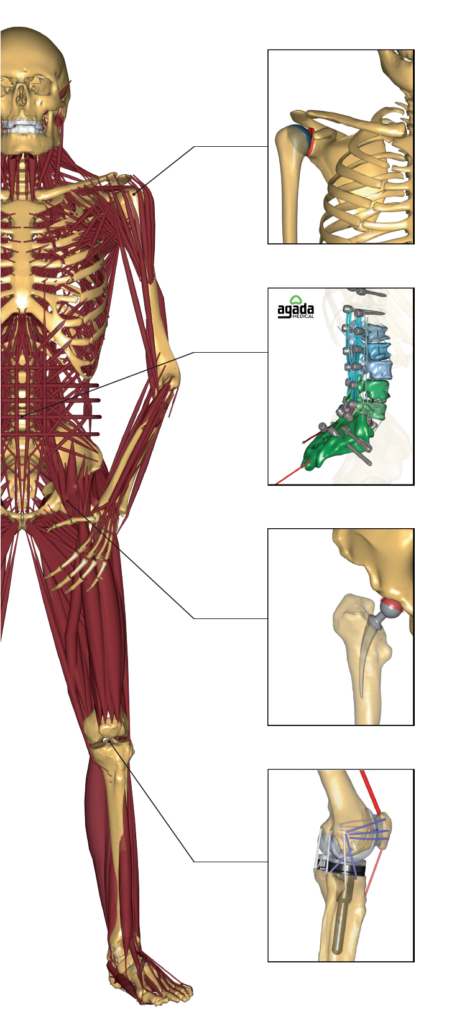
Examples of Orthopedic applications
- Knee – total, partial arthroplasty, ACL/PCL reconstruction etc.
- Hip – total, partial arthroplasty, acetabular cup, fixation nails & screws etc.
- Shoulder – total, reverse, hemi-arthroplasty, clavicular plates etc.
- Spine – disc replacements, pedicle screws, fixators etc.
- Patient-specific solutions
and more…
Selected research
- Andres A, Roland M, Wickert K, Diebels S, Histing T, Braun B, (2025), “Predicting the effect of individual weight-bearing on tibial load and fracture healing after tibial plateau fractures – introduction of a biomechanical simulation model”. Research Square, [ DOI, WWW ]
- Peixoto M, Soyeux D, Tétreault P, Begon M, Hagemeister N, (2025), “Effect of congruence variations on a musculoskeletal model considering humeral head displacements”. J. Biomech., vol. 190, pp. 112885. [ DOI, WWW ]
- Andres A, Wickert K, Gneiting E, Binmoeller F, Diebels S, Roland M, (2025), “Simulation of a custom-made temporomandibular joint—an academic view on an industrial workflow”. Bioengineering (Basel), vol. 12, pp. 545. [ DOI, WWW ]
- Menze J, Croci E, Andersen MS, Hess H, Lund ME, De Pieri E, Zumstein MA, Ferguson SJ, Müller AM, Mündermann A, Gerber K, (2025), “Advancing musculoskeletal shoulder modeling: reflecting glenohumeral translation with bony, ligamentous, and muscular stability constraints”. Front. Bioeng. Biotechnol., vol. 13, [ DOI, WWW ]
- Zhang Q, Chen Z, Peng Y, Jin Z, Qin L, (2023), “The novel magnesium–titanium hybrid cannulated screws for the treatment of vertical femoral neck fractures: Biomechanical evaluation”. Journal of Orthopaedic Translation, vol. 42, pp. 127-136. [ DOI, WWW]
- Esrafilian A, Halonen KS, Dzialo CM, Mannisi M, Mononen ME, Tanska P, Woodburn J, Korhonen RK, Andersen MS, (2023), “Effects of gait modifications on tissue-level knee mechanics in individuals with medial tibiofemoral osteoarthritis: A proof-of-concept study towards personalized interventions”. J. Orthop. Res., [ DOI, WWW ]
- Menze J, Leuthard L, Wirth B, Audigé L, De Pieri E, Gerber K, Ferguson SJ, (2023), “The effect of pathological shoulder rhythm on muscle and joint forces after reverse shoulder arthroplasty, a numerical analysis”. Clin. Biomech. , [ DOI, WWW ]
- Rothammer B, Wolf A, Winkler A, Schulte-Hubbert F, Bartz M, Wartzack S, Miehling J, Marian M, (2023), “Subject-specific tribo-contact conditions in total knee replacements: a simulation framework across scales”. Biomech. Model. Mechanobiol., [ DOI, WWW ]
- Zhang Q, Peng Y, Chen Z, Jin Z, Qin L, (2023), “Conformity design can change the effect of tibial component malrotation on knee biomechanics after total knee arthroplasty”. Clin. Biomech. , [ DOI, WWW ]
- Tzanetis P, Fluit R, de Souza K, Robertson S, Koopman B, Verdonschot N, (2023), “Pre-Planning the Surgical Target for Optimal Implant Positioning in Robotic-Assisted Total Knee Arthroplasty”. Bioengineering, vol. 10, pp. 543. [ DOI, WWW ]
- Bayoglu R, Witt JP, Chatain GP, Okonkwo DO, Ignasiak D, (2023), “Clinical Validation of a Novel Musculoskeletal Modeling Framework to Predict Postoperative Sagittal Alignment”. Spine , vol. Publish Ahead of Print, [ DOI, WWW ]
- Ignasiak D, Behm P, Mannion AF, Galbusera F, Kleinstück F, Fekete TF, Haschtmann D, Jeszenszky D, Zimmermann L, Richner-Wunderlin S, Vila-Casademunt A, Pellisé F, Obeid I, Pizones J, Sánchez Pérez-Grueso FJ, Karaman MI, Alanay A, Yilgor Ç, Ferguson SJ, Loibl M, ESSG European Spine Study Group, (2022), “Association between sagittal alignment and loads at the adjacent segment in the fused spine: a combined clinical and musculoskeletal modeling study of 205 patients with adult spinal deformity”. Eur. Spine J., [ DOI, WWW ]
- De Pieri E, Cip J, Brunner R, Weidensteiner C, Alexander N, (2022), “The functional role of hip muscles during gait in patients with increased femoral anteversion”. Gait Posture, [ DOI, WWW ]
- Flores C, Celik H, Hoenecke H, D’Lima DD, (2022), “Subject-Specific Computational Modeling of Acromioclavicular and Coracoclavicular Ligaments”. J. Shoulder Elbow Surg., [ DOI, WWW ]
- De Pieri E, Friesenbichler B, List R, Monn S, Casartelli NC, Leunig M, Ferguson SJ (2021), “Subject-Specific Modeling of Femoral Torsion Influences the Prediction of Hip Loading During Gait in Asymptomatic Adults“, Front Bioeng Biotechnol, vol. 9, pp. 679360. [DOI]
- Andersen MS, Dzialo CM, Marra MA, Pedersen D (2021), “A Methodology to Evaluate the Effects of Kinematic Measurement Uncertainties On Knee Ligament Properties Estimated From Laxity Measurements“, J. Biomech. Eng.. [DOI]
- Rasmussen J, Iversen K, Engelund BK, Rasmussen S (2021), “Biomechanical Evaluation of the Effect of Minimally Invasive Spine Surgery Compared with Traditional Approaches in Lifting Tasks“, Frontiers in Bioengineering and Biotechnology. [PDF, DOI]
- Tzanetis P, Marra MA, Fluit R, Koopman B, Verdonschot N (2021), “Biomechanical Consequences of Tibial Insert Thickness after Total Knee Arthroplasty: A Musculoskeletal Simulation Study“, Applied sciences. [DOI, WWW]
Recent orthopedics webcasts
- Optimizing Fracture Healing: Realistic Boundary Conditions
- Personalized Musculoskeletal Modeling to Predict Total Knee Arthroplasty Mechanics from Clinical Input Data
- Impacts of ligament stiffness adjustment on knee joint mechanics in mechanically aligned PS-TKA
- In silico approach for personalized gait modification to decelerate knee osteoarthritis progression
- Toward personalized total knee arthroplasty – Pre-planning the patient’s optimal joint function in robotic-assisted surgery
- Increased femoral anteversion in children – can musculoskeletal modeling better inform clinical decision-making?
- Patient-Specific Spine Analytics
- The future of personalized orthopedics: Kinematic modeling to restore premorbid knee functionality through robotic assisted TKA
- The role of the anterior hip capsule in daily hip performance
- Modeling subject-specific femoral torsion for the analysis of lower-limb joint loads
- A Model-based methodology to predict the biomechanical consequences of tibial insert thickness after total knee arthroplasty
- A methodology to evaluate the effects of kinematic measurement uncertainties on knee ligament properties estimated from laxity measurements
- Subject-specific lower limb modeling and evaluation with a force-dependent kinematics natural knee model
- Understanding the mechanical environment of the hip joint
- Advancing knee joint modeling towards clinical use
- Development, validation and clinical applications of patient-specific musculoskeletal knee models