
Target better man-machine synergy
Our technology enables you to create wearable assistive devices, robots and exoskeletons that are safe, comfortable and reliably meet their biomechanical expectations. Whether you are a designer, tester, or purchaser of such devices, our products and services can help you analyze and quantify the effect of these devices on the user and make the right and cost-effective choices. Not only can you quantify the effects on the user, but you can also specify the requirements of the assistive device using our technology.
Our tools and technology have been used to assess assistive devices intended for use in all kinds of fields such as industrial, medical (rehabilitative), military, aerospace.
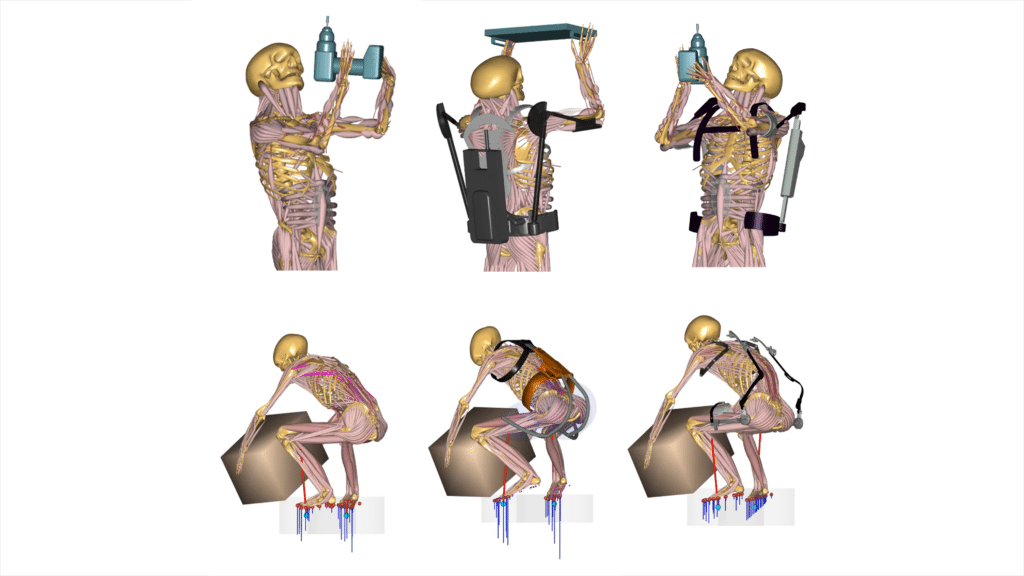
Applications for musculoskeletal modeling and simulation of assistive devices
“The AnyBody Modeling System can simulate trunk muscles that cannot otherwise be measured by normal myoelectricity. In addition, it can calculate joint forces that cannot be captured easily, which makes the software essential for correct estimation of the effect of our exoskeleton. The results and visualizations are additionally used in our promotional videos and has received great feedback from our customers.” Daigo Orihara, CEO Innophys Co., Ltd.
Selected research
- Gu D, Kang D, Kim YJ, Lee YH, Moon JI, Park S, Choi JK, Jung MK, Kim Y, (2026), “Biomechanical effectiveness and wearability of a passive shoulder exoskeleton in an automotive assembly”. Appl. Sci. (Basel), vol. 16, pp. 7192. [ DOI, WWW ]
- Nasirzadeh A, Kim W, Yang J, Driscoll HG, Lee G, (2026), “Biomechanical effects of passive exosuit assistance on tibiofemoral loading and dynamic stability during downhill walking”. J. Neuroeng. Rehabil., [ DOI, WWW ]
- Jayasuriya J, Bazzocchi MC, Fite K, Martinez M, (2026), “Modeling and analysis of firefighter musculoskeletal biomechanics for lower-extremity exoskeleton”. J. Safety Res., vol. 97, pp. 696-711. [ DOI, WWW ]
- Zhang L, Zhu M, Jiang S, Jiang B, (2026), “Design and evaluation of a passive knee-ankle exoskeleton for walking and squatting: a musculoskeletal simulation study”. Med. Biol. Eng. Comput., [ DOI, WWW ]
- Tröster M, Eckstein S, Kennel P, Kopp V, Benkiser A, Bihlmeier F, Daub U, Maufroy C, Dendorfer S, Fritzsche L, Schneider U, Bauernhansl T, (2025), “Person-specific evaluation method for occupational exoskeletons – Biomechanical body heat map”. Appl. Ergon., vol. 132, pp. 104671. [ DOI, WWW ]
- Nasirzadeh A, Lee SM, Jang J, Ryu J, Choo J, Ko N, Kim JH, Kwon YU, Lee G, (2025), “Harnessing resistance: the impact of a passive exosuit on golf swing biomechanics”. J. Biomech., vol. 192, pp. 112958. [ DOI, WWW ]
- Le DK, Lin WC, (2025), “Development of a grasshopper‐leg‐inspired back‐type exoskeleton for the reduction of muscle activation during stoop activities”. J. Field Robot., [ DOI ]
- Rasmussen J, (2025), “From knowledge to leverage: How to use musculoskeletal simulation to design exoskeleton concepts”. Appl. Sci. (Basel), vol. 15, pp. 5903. [ DOI, WWW ]
- Nagaraja S, Rubio JE, Tong J, Sundaramurthy A, Pant A, Owen MK, Samaan MA, Noehren B, Reifman J, (2025), “Effects of an active ankle exoskeleton on the walking biomechanics of healthy men”. Front. Bioeng. Biotechnol., vol. 13, [ DOI, WWW ]
- Madinei S, Nussbaum MA, (2023), “Estimating Lumbar Spine Loading When Using Back-Support Exoskeletons in Lifting Tasks”. J. Biomech., pp. 111439. [ DOI, WWW ]
- Scherb D, Wartzack S, Miehling J, (2023), “Modelling the interaction between wearable assistive devices and digital human models—A systematic review”. Frontiers in Bioengineering and Biotechnology, vol. 10, [ DOI, WWW ]
- Musso M, Oliveira AS, Bai S, (2022), “Modeling of a Non-Rigid Passive Exoskeleton-Mathematical Description and Musculoskeletal Simulations”. Robotics, [ DOI, WWW ]
- Shengxian Y, Zongxing L, Jing W, Lin G, (2022), “The effect of the 2-UPS/RR ankle rehabilitation robot with coupling biomechanical model on muscle behaviors”. Med. Biol. Eng. Comput., [ DOI ]
- Auer S, Tröster M, Schiebl J, Iversen K, Chander D, Damsgaard M, Dendorfer S, (2022), “Biomechanical assessment of the design and efficiency of occupational exoskeletons with the AnyBody Modeling System”. Zeitschrift für Arbeitswissenschaft, [ DOI ]
- Schiebl J, Tröster M, Idoudi W, Gneiting E, Spies L, Maufroy C, Schneider U, Bauernhansl T, (2022), “Model-Based Biomechanical Exoskeleton Concept Optimization for a Representative Lifting Task in Logistics”. International Journal of Environmental Research and Public Health, vol. 19, pp. 15533. [ DOI, WWW ]
- Böhme M, Köhler HP, Thiel R, Jäkel J, Zentner J, Witt M, (2022), “Preliminary Biomechanical Evaluation of a Novel Exoskeleton Robotic System to Assist Stair Climbing”. Applied Sciences, vol. 12, [ DOI, WWW ]
- Tröster M, Budde S, Maufroy C, Andersen MS, Rasmussen J, Schneider U, Bauernhansl T, (2022), “Biomechanical Analysis of Stoop and Free-Style Squat Lifting and Lowering with a Generic Back-Support Exoskeleton Model”. Int. J. Environ. Res. Public Health, [ DOI, WWW ]
- Seiferheld BE, Frost J, Krog M, Skals S, Andersen MS, (2022), “Biomechanical investigation of a passive upper-extremity exoskeleton for manual material handling – a computational parameter study and modelling approach”. International Journal of Human Factors Modelling and Simulation (IJHFMS), vol. 7, [ DOI ]
- Schmalz T, Colienne A, Bywater E, Fritzsche L, Gärtner C, Bellmann M, Reimer S, Ernst M (2021), “A passive back-support exoskeleton for manual materials handling: Reduction of low back loading and metabolic effort during repetitive lifting“, IISE Trans Occup Ergon Hum Factors, pp. 1-15. [DOI, WWW]
- Fritzsche L, Galibarov P, Gärtner C, Bornmann J, Damsgaard M, Wall R, Schirrmeister B, Gonzalez-Vargas J, Pucci D, Maurice P (2021), “Assessing the efficiency of exoskeletons in physical strain reduction by biomechanical simulation with AnyBody Modelling System“, HAL.
- Tröster M, Wagner D, Müller-Graf F, Maufroy C, Schneider U, Bauernhansl T. Biomechanical Model-Based Development of an Active Occupational Upper-Limb Exoskeleton to Support Healthcare Workers in the Surgery Waiting Room. International Journal of Environm
Recent webcasts:
- Biomechanical Simulation of Passive Back-Support Exoskeletons: Effects of Actuator Strength on Musculoskeletal Load and Contact Stress
- Digital Exonomics | Musculoskeletal Exoskeleton Assessment with AnyBody
- An introduction to exoskeleton design using musculoskeletal modeling
- Simulation-Driven Conceptual Design of Exoskeletons
- Investigation of bracing to unload muscle and knee contact forces for knee osteoarthritis patients
- Biomechanical investigation of a passive upper extremity exoskeleton for manual material handling – A computational parameter study
- Occupational exoskeletons as advanced ergonomic devices – How the AnyBody Modeling System can be applied
- Introduction to Innophys and their wearable exoskeleton
- Simulations as a tool for human-centered exoskeleton design