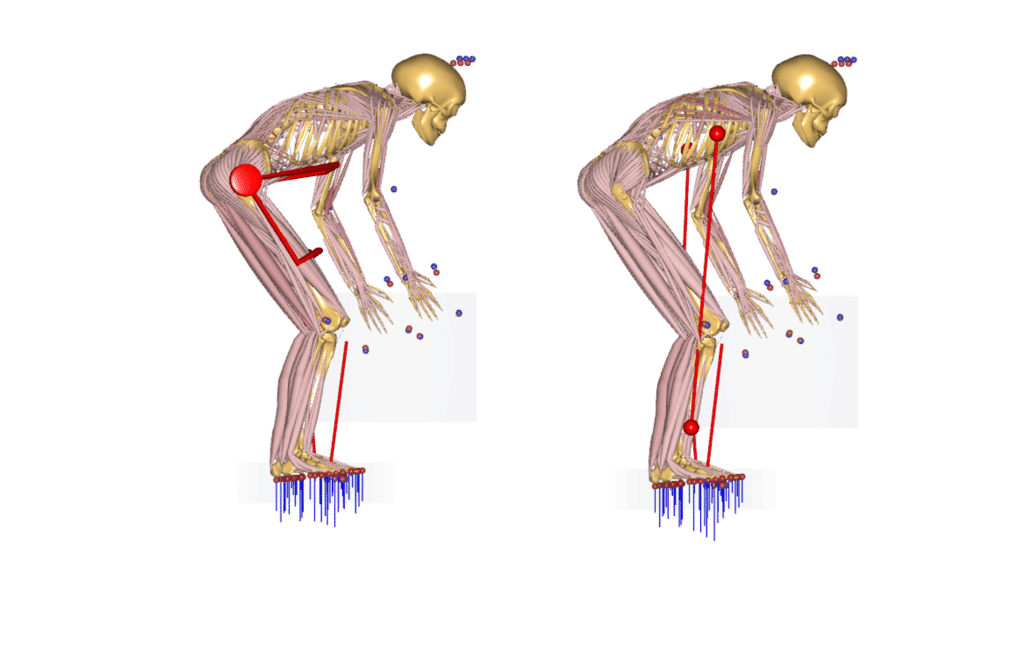
Explore your assistive device design ideas during the conceptual state of your design phase by modeling different assistance concepts before beginning virtual prototyping. Investigate if your device concepts reliably meet their biomechanical expectations. Compute internal joint loads, stress redistribution, and compensatory mechanisms inside the human musculoskeletal system, and digitally test and optimize your exoskeleton concepts with AnyBody Modeling System. Compare with and without exoskeleton assistance concept and define assistive torque requirement and related key exoskeleton specifications.
Examples in modeling assistive device design ideas
- Compute ideal assistive force or torque requirement.
- Apply idealized assistance directly to joints.
- Model and test different assistance concepts.
- Evaluate changes in the internal body loads (e.g., muscle activities, joint reaction forces, compression forces etc.)
- Analyze internal body load redistribution due to different assistance concepts.
- Investigate how different mechanical design parameters can affect the user.
- Simulation-based design of exoskeletons using musculoskeletal analysis.
- Modeling and simulation of a lower extremity exoskeleton.
- Modeling and simulation of an upper extremity exoskeleton.
- Simulation-based design of exoskeletons using musculoskeletal analysis.
“The AnyBody Modeling System can simulate trunk muscles that cannot otherwise be measured by normal myoelectricity. In addition, it can calculate joint forces that cannot be captured easily, which makes the software essential for correct estimation of the effect of our exoskeleton. The results and visualizations are additionally used in our promotional videos and has received great feedback from our customers.”
Daigo Orihara, CEO Innophys Co., Ltd.


Tutorials
Webcasts
- Digital Exonomics | Musculoskeletal Exoskeleton Assessment with AnyBody
- An introduction to exoskeleton design using musculoskeletal modeling
- Simulation-Driven Conceptual Design of Exoskeletons
- Biomechanical investigation of a passive upper extremity exoskeleton for manual material handling – A computational parameter study
- Occupational exoskeletons as advanced ergonomic devices – How the AnyBody Modeling System can be applied
- Offline multilevel ergonomic assessment of workplaces with assistive machines
- Introduction to Innophys and their wearable exoskeleton
- Simulations as a tool for human-centered exoskeleton design
- Assistive Devices: Simulating Physiological Performance
Models in AMMR
Selected papers
- Zhang L, Zhu M, Jiang S, Jiang B, (2026), “Design and evaluation of a passive knee-ankle exoskeleton for walking and squatting: a musculoskeletal simulation study”. Med. Biol. Eng. Comput., [ DOI, WWW ]
- Tröster M, Eckstein S, Kennel P, Kopp V, Benkiser A, Bihlmeier F, Daub U, Maufroy C, Dendorfer S, Fritzsche L, Schneider U, Bauernhansl T, (2025), “Person-specific evaluation method for occupational exoskeletons – Biomechanical body heat map”. Appl. Ergon., vol. 132, pp. 104671. [ DOI, WWW ]
- Rasmussen J, (2025), “From knowledge to leverage: How to use musculoskeletal simulation to design exoskeleton concepts”. Appl. Sci. (Basel), vol. 15, pp. 5903. [ DOI, WWW ]
- Park S, Jung MK, Kim K, Lim H, Yoon J, Hyun DJ, (2025), “Correlations between biomechanical variables and subjective measures of satisfaction while using a passive upper-limb exoskeleton for overhead tasks in the field”. IEEE Trans. Hum. Mach. Syst., pp. 1-9. [ DOI, WWW ]
- Le DK, Lin WC, (2025), “Development of a grasshopper‐leg‐inspired back‐type exoskeleton for the reduction of muscle activation during stoop activities”. J. Field Robot., [ DOI ]
- Auer S, Tröster M, Schiebl J, Iversen K, Chander D, Damsgaard M, Dendorfer S, (2022), “Biomechanical assessment of the design and efficiency of occupational exoskeletons with the AnyBody Modeling System”. Zeitschrift für Arbeitswissenschaft, [ DOI ]
- Böhme M, Köhler HP, Thiel R, Jäkel J, Zentner J, Witt M, (2022), “Preliminary Biomechanical Evaluation of a Novel Exoskeleton Robotic System to Assist Stair Climbing”. Applied Sciences, vol. 12, [ DOI, WWW ]
- Schiebl J, Tröster M, Idoudi W, Gneiting E, Spies L, Maufroy C, Schneider U, Bauernhansl T, (2022), “Model-Based Biomechanical Exoskeleton Concept Optimization for a Representative Lifting Task in Logistics”. International Journal of Environmental Research and Public Health, vol. 19, pp. 15533. [ DOI, WWW ]
- Castro MN, Rahman T, Nicholson KF, Rasmussen J, Bai S, Andersen MS (2020), “A Case Study on Designing a Passive Feeding-Assistive Orthosis for Arthrogryposis“, J. Med. Device., vol. 14. [DOI, WWW]
- Castro MN, Rasmussen J, Andersen MS, Bai S (2019), “A compact 3-DOF shoulder mechanism constructed with scissors linkages for exoskeleton applications“, Mechanism and Machine Theory, vol. 132, pp. 264-278. [DOI, WWW]
- Spada S, Ghibaudo L, Carnazzo C, Di Pardo M, Chander DS, Gastaldi L, Cavatorta MP (2019), “Physical and Virtual Assessment of a Passive Exoskeleton“, In: Proceedings of the 20th Congress of the International Ergonomics Association (IEA 2018), pp. 247-257. [DOI]
- Fournier BN, Lemaire ED, Smith AJJ, Doumit M (2018), “Modeling and Simulation of a Lower Extremity Powered Exoskeleton“, IEEE Trans. Neural Syst. Rehabil. Eng., vol. 26, pp. 1596-1603. [DOI]
- Tröster M, Schneider U, Bauernhansl T, Rasmussen J, Andersen MS (2018), “Simulation Framework for Active Upper Limb Exoskeleton Design Optimization Based on Musculoskeletal Modeling“, In: Smart ASSIST, pp. 345-353.