Sign up to our newsletter
Sign up to receive webinar invitations, information about events and other news!
PhD Course – Welcome to Musculoskeletal Modeling by Multibody Dynamics
Date: March 16 – 20, 2026
Location: Aalborg, Denmark
Webcast: Subscapularis Integrity and Posterosuperior Cuff Tear Severity Affect Scapular Impingement and Joint Stability in Reverse Total Shoulder Arthroplasty: Medialization vs. Lateralization
Date: March 17, 2026 at 9 AM (CET)
This study provides a comprehensive overview of the interaction between reverse total shoulder arthroplasty (RTSA) designs, subscapularis integrity, and posterosuperior cuff tear severity. Using the AnyBody Modeling System, the study quantified impingement stress and joint translation to determine which RTSA configuration, combined with subscapularis status, more effectively minimizes scapular notching-related impingement stress and improves joint stability. This webcast demonstrates how musculoskeletal model simulations can inform surgical planning. It highlights the potential benefits of lateralized RTSA with subscapularis repair in reducing the risk of scapular notching and improving joint stability.
Presented by:
Donghwan Lee, Ph.D. Candidate
Department of Mechanical Engineering, Sogang University, Republic of Korea
ORS 2026 – The annual meeting of the Orthopaedic Research Society
Date: March 27 – 31, 2026
Location: Charlotte, North Carolina
- Read more about the conference at the official website here.
Previous events
AnyBody Solution Days
Date: February 11-12, 2026
Location: Online
On February 11-12, 2026 we are hosting the online AnyBody Solutions Days.
If you need help with your AnyBody modeling task or have some specific questions to your work, feel free to book a free 30 minutes online support session with one of our engineers.
Note: Valid AnyBody Modeling System maintenance subscription is required
Webcast: Sphere-on-Sphere model: shoulder model including humeral head translation
Date: January 15, 2026 at 3 PM (CET)
This webinar will present a musculoskeletal shoulder model that uses a sphere-on-sphere representation of the glenohumeral joint together with force-dependent kinematics (FDK) to enable realistic translation of the humeral head, rather than using a ball-and-socket representation of the joint. This results in more physiologically plausible kinematics of the humeral head and more realistic muscle activation patterns, especially for the cuff muscles. The model improves the ability to investigate glenohumeral stability, including the impact of variations in joint congruence or rotator cuff tear configurations on muscle compensation and joint loading.
The full model is available on GitHub (DOI 10.5281/zenodo.17279962).
Presented by:
Margaux Peixoto
PhD Candidate at École de Technologie Supérieure Montreal
Webcast: Evaluation of a universal talus implant during gait: a combined musculoskeletal and finite element modelling approach
Date: December 18, 2025 at 9 AM (CET)
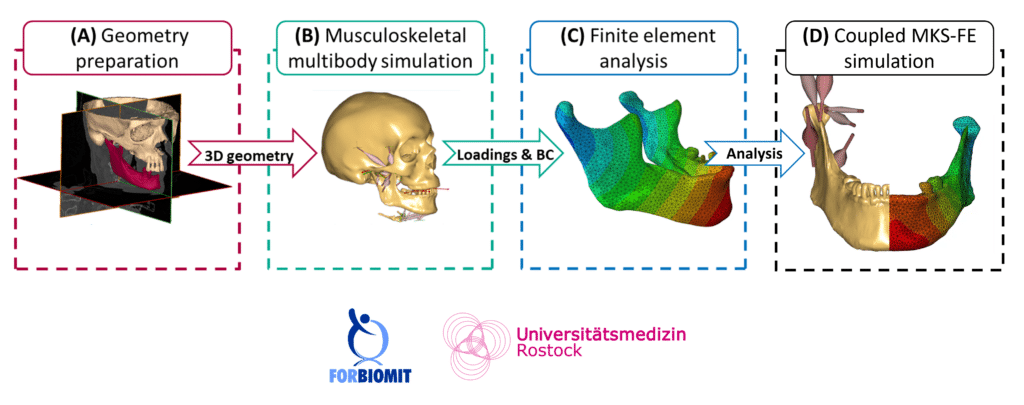
This study presents a combined musculoskeletal and finite element modelling approach to evaluate the dynamic performance of a previously developed universal talus implant by looking at articular contact behavior in the ankle complex during gait. The focus of the analysis is on contact stresses on peri-talar cartilages and on the role of the addition of a compliant layer to the originally purely metallic implant.
Presented by:
Sami Al Shweiki
MSc in Biomedical Engineering
ETH Zurich & Khalifa University
Webcast: Biomechanical Simulation of Passive Back-Support Exoskeletons: Effects of Actuator Strength on Musculoskeletal Load and Contact Stress
Date: November 5, 2025 at 4 PM (CET) / 9 AM (CST)
Exoskeleton-integrated musculoskeletal modeling offers a systematic framework for human-in-the-loop design of exoskeletons, enabling the simulation-based evaluation of various support levels to minimize the cost and time-consuming tests with human subjects. This approach also helps prevent mismatches such as over- or under-sized actuators, allowing for more effective application in real-world scenarios. In this webcast, we will briefly discuss how exoskeletons can be integrated into digital human models and review different interaction modeling approaches. Then, we will demonstrate how the AnyBody Modeling System can be used to systematically evaluate the effects of various exoskeleton support levels on biomechanical load and contact stress in an occupational task.
Presented by:
Jay Kim, PhD, Associate Professor | Texas A&M University
Environmental and Occupational Health
Industrial and Systems Engineering
Center for Worker Health
Mina Salehi, MS, PhD Candidate | Oregon State University
Environmental and Occupational Health
Visiting scholar @ Texas A&M University