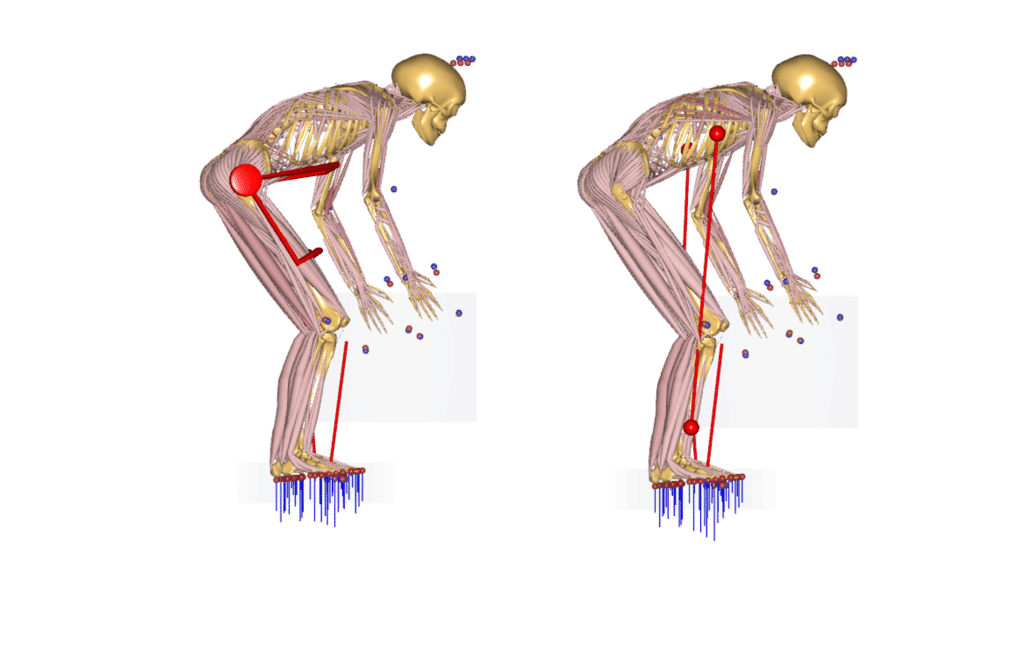
Are you facing a situation where you think an assistive device can be useful? You can take the guesswork out by using our technology. Use our musculoskeletal simulations to analyze the internal joint loads in the activity in question and compare it to those in a reference activity. Quantify the excess joint loading and define requirements for the assistive device.
Examples
- Use simulation studies to analyze the activity where an assistive device could be useful.
- Quantify the internal joint loads and muscle activity in the target activity.
- Quantify the internal joint loads and muscle activity in a reference activity of daily living, such as gait.
- Compare the internal loads in the target activity to loads from ergonomic standards such as NIOSH, or to loads from reference activities.
- Quantify the excess loading in a target activity with respect to ergonomic standards or reference activities.
- Identify the opportunity for an assistive device and define the requirements for the assistive device.
“The AnyBody Modeling System can simulate trunk muscles that cannot otherwise be measured by normal myoelectricity. In addition, it can calculate joint forces that cannot be captured easily, which makes the software essential for correct estimation of the effect of our exoskeleton. The results and visualizations are additionally used in our promotional videos and has received great feedback from our customers.”
Daigo Orihara, CEO Innophys Co., Ltd.


Tutorials
Webcasts
- Digital Exonomics | Musculoskeletal Exoskeleton Assessment with AnyBody
- An introduction to exoskeleton design using musculoskeletal modeling
- Simulation-Driven Conceptual Design of Exoskeletons
- Biomechanical investigation of a passive upper extremity exoskeleton for manual material handling – A computational parameter study
- Occupational exoskeletons as advanced ergonomic devices – How the AnyBody Modeling System can be applied
- Introduction to Innophys and their wearable exoskeleton
Models in AMMR
Selected papers
- Zhang L, Zhu M, Jiang S, Jiang B, (2026), “Design and evaluation of a passive knee-ankle exoskeleton for walking and squatting: a musculoskeletal simulation study”. Med. Biol. Eng. Comput., [ DOI, WWW ]
- Tröster M, Eckstein S, Kennel P, Kopp V, Benkiser A, Bihlmeier F, Daub U, Maufroy C, Dendorfer S, Fritzsche L, Schneider U, Bauernhansl T, (2025), “Person-specific evaluation method for occupational exoskeletons – Biomechanical body heat map”. Appl. Ergon., vol. 132, pp. 104671. [ DOI, WWW ]
- Rasmussen J, (2025), “From knowledge to leverage: How to use musculoskeletal simulation to design exoskeleton concepts”. Appl. Sci. (Basel), vol. 15, pp. 5903. [ DOI, WWW ]
- Auer S, Tröster M, Schiebl J, Iversen K, Chander D, Damsgaard M, Dendorfer S, (2022), “Biomechanical assessment of the design and efficiency of occupational exoskeletons with the AnyBody Modeling System”. Zeitschrift für Arbeitswissenschaft, [ DOI ]
- Schiebl J, Tröster M, Idoudi W, Gneiting E, Spies L, Maufroy C, Schneider U, Bauernhansl T, (2022), “Model-Based Biomechanical Exoskeleton Concept Optimization for a Representative Lifting Task in Logistics”. International Journal of Environmental Research and Public Health, vol. 19, pp. 15533. [ DOI, WWW ]
- Tröster M, Wagner D, Müller-Graf F, Maufroy C, Schneider U, Bauernhansl T, (2020), “Biomechanical Model-Based Development of an Active Occupational Upper-Limb Exoskeleton to Support Healthcare Workers in the Surgery Waiting Room”. Int. J. Environ. Res. Public Health, vol. 17, [ DOI, WWW ]