
AnyBody newsletter: Highlights of the new v. 5.1, ISB seminar, FE interface updates, US-based Sales Executive vacancy
- New software release: Highlights of The AnyBody Modeling System v. 5.1
- AnyBody seminar at the ISB2011 in Brussels July 6
- Finite element interface updates
- Cooperation with the AnyBody Research Group
- Webcasts
- US sales executive vacancy
- Bonezone magazine cover image
- Meet two AnyBuddies: Amir A. Al-Munajjed and Tony Petrella
- Conferences: Meet AnyBody at...
- Recent publications
New software release: Highlights of The AnyBody Modeling System v. 5.1 Combined with an enhanced solver for force-dependent kinematics(TM) - a feature included in the AnyBody Modeling System in version 5.0, AnyBody is now equipped to define and analyze detailed and advanced models of non-conforming joints such as the knee during activities of daily living. The knee model which is being developed by Michael Skipper Andersen, Aalborg University was previously presented in a webcast (available for download and replay here). It's being currently being updated for demonstrating the use of the new contact modeling facilities, cf. the image enclosed. V.5.1 also features the first possibility of hooking external code directly into the AnyBody simulation. This option allows AnyScript functions to be programmed as external C++ or Python code. The hook transfers function arguments to the external code and the resulting output back into the AnyScript expression from which the function was called. Hooking into the AnyBody has numerous potential applications, for instance it allows the user to program advanced force functions for calculating applied forces to the model. Version 5.1 of AnyBody Modeling System is planned for release in August this year. Notice that Head of AnyBody Technology R&D Michael Damsgaard, PhD, will be giving a webcast overview of v. 5.1 on June 22 which will be followed up by two webcasts in September by Prof. John Rasmusen going into more details with the above mentioned features, cf. the webcast announcements below. | ||
AnyBody seminar at the ISB2011 in Brussels July 6 It's Wednesday afternoon at 16:00 during the International Biomechanics Society conference in Brussels, Belgium. Read more here... |
| |
Finite element interface updates Unsatisfactory as this has been - especially for people investing a significant effort in creating sophisticated FE models - better data was also been very difficult to get hold off. The new situation is that the AnyBody Modeling System provides exactly those dynamic physiogical load data illustrated by the yellow "spider web" load corresponding to AnyBody muscle and ligament pulls on the SIMULIA Abaqus FE-mesh. The figure below shows the new improved interface workflow to SIMULIA Abaqus. A new Abaqus lesson describing the interfacing in more detail has also been added to the general FE interfacing tutorial which can be found here.
| ||
Cooperation with the AnyBody Research Group | ||
Webcasts
A comprehensive library of previously recorded webcast is available for download and replay here. | ||
BONEZONE magazine cover image | ||
US sales executive vacancy | ||
Meet two AnyBuddies: Amir A. Al-Munajjed and Tony Petrella
| ||
Conferences: Meet AnyBody at... 30 Jun-2 Jul, ISB Technical group on Computer Simulation in Biomechanics, Leuven, Belgium 3-7 Jul, ISB2011, Brussels, Belgium 26-27 Aug, Symposium on Numerical Simulation in Orthopaedic Biomechanics, Rostock, Germany 29 Aug-2 Sep: SpineFX Computational Biomechanics Workshop, Vienna, Austria 7-9 Sep: FDA/NHLBI/NSF workshop on computer methods for medical devices, Silver Spring, MD | ||
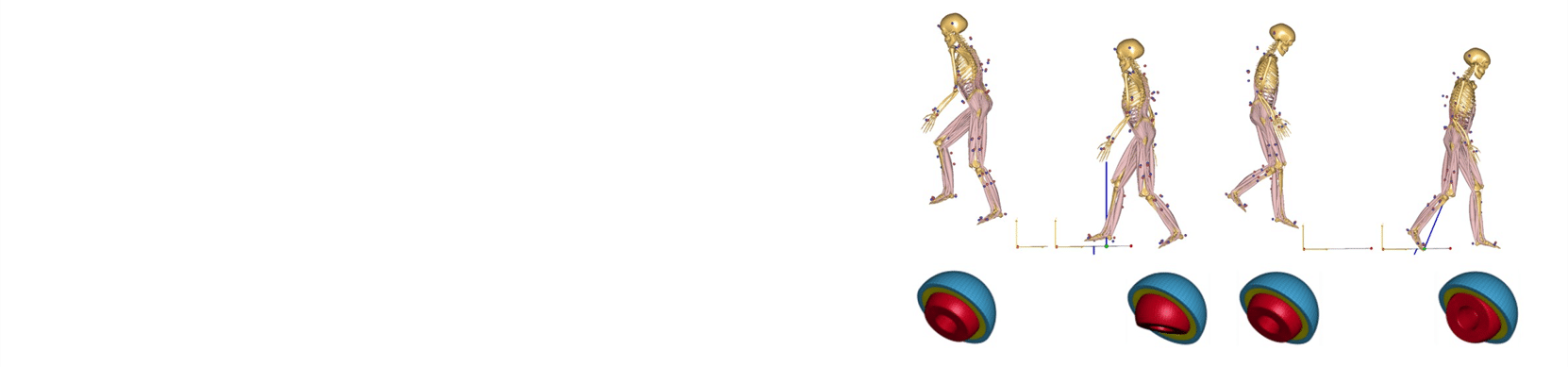
Publications Peter Worsley, Maria Stokes, and Mark Taylor at University of Southampton, UK, ran 20 healthy older subjects using motion capture data and inverse dynamic AnyBody musculoskeletal models during gait, sit–stand–sit, and step–descent. One important finding was the variability found across the subjects in all of the activities for both kinematics and kinetics: Paul Taylor at Dept. of Orthopaedic Surgery, Fremantle Hospital, Australia, and co-workers look at the optimal plate location and fixation method for midshaft fractures of the clavicle which remains undetermined. They develop a realistic biomechanical model with which to compare superior with inferior-medial plate placement, and the failure resistance of locked and against non-locked constructs: Ben Gadomski at Colorado State University and co-workers compare results from an AnyBody model with current in vitro practices for spine research involving pure moments and compressive follower loads for flexion, extension, lateral bending, and axial rotation. Encouraging for our trade, inclusion of muscles is important to obtain physiological loads and the AnyBody model most closely predicted in vivo intradiscal pressures: Karl Siebertz and Jessica Rausch at Ford Research Center Aachen, Germany, present a detailed, validated AnyBody model for comfort evaluation: Sonia d'Souza from Daimler AG and coworkers are developing methods for age and gender based strength scaling of models. The first results from this work is presented here: Motomu Nakashima and Taku Komura from Tokyo Inst. of Technology developed and validated an AnyBody model of a pregnant wowan and used it for investigating in muscle forces for standing, flexion-extension, and seating: Anders Sandholm from École Polytechnique Fédérale de Lausanne, Switzerlandand and coworkers shows that a a geometry-based knee joint (developed in AnyBody) predicts muscle activation and joint reaction forces for gait better than a planar knee joint (developed in another system): Maxine Kwan who received her PhD supervised by John Rasmussen last year has summarized some of her thesis work on badminton here: In this overview article looking at several different types of models Marc Horner from ANSYS, Inc, discuss lumped parameter models versus geometrically accurate models. As a musculoskeletal example of the latter he uses a patient-specific workflow involving software from Materialise, AnyBody Technology, and ANSYS. The workflow features the extraction of a patient bone from medical scan data, the derivation of joint motions and loads from a walking cycle, and the application of this information to a femur and acetabular implant: Several AnyBody-related papers were present at the recent annual meeting of the German Society of Biomechanics. From Hannover Medical School and TU Berlin, and Hannover Medical School and Otto Bock GmbH, respectively, they include:
|

Computing contact forces between arbitrary surfaces is the key new feature included in the upcoming version 5.1. The surfaces are imported as STL files and as such they can take any form and be produced from general CAD data for your orthopedic device or product. 
Amir, 32, from Germany, joined the AnyBody team in March 2011 as a Sr. Consultant. With his biomedical and orthopedic engineering background, he supports the AnyBody consulting team working mostly on projects involving joint replacements i.e. hip, knee, shoulder. Amir joined us from the Royal College of Surgeons in Ireland & Trinity College after finishing his PhD in 2009. His research involved investigating implants for bone healing and fracture repair using biomechanical, biomaterial, computational, stem cell and animal studies. Amir finished his Diplom-Ingenieur in Regensburg and a Master of Science at the Technical University Munich analyzing orthopedic implants and biomaterials for musculoskeletal repair. Due to his academic achievements, Amir is also reviewer for several orthopedic journals. In his spare time, Amir likes many kinds of sports. He recently joined a basketball team in Aalborg, he likes running, cycling and hiking. He also likes traveling to VERY remote places like Easter Island, the Kingdom of Tonga. He is currently preparing a trip to Mt. Everest.
Tony Petrella is Assistant Professor of Bioengineering at the Colorado School of Mines in Golden, CO. He is also Director of the Mines Computational Biomechanics Group, which applies a variety of simulation methods to problems in musculoskeletal and orthopaedic biomechanics. Prior to joining Mines in 2006, he managed the computational biomechanics group at DePuy Orthopaedics where he oversaw development and application of computer simulation tools to support product design teams working on new medical devices for both joint replacement as well as fracture/trauma applications.